Education / Community Services · Cloud Flow Library (Dhaka)
Cloud Flow Library
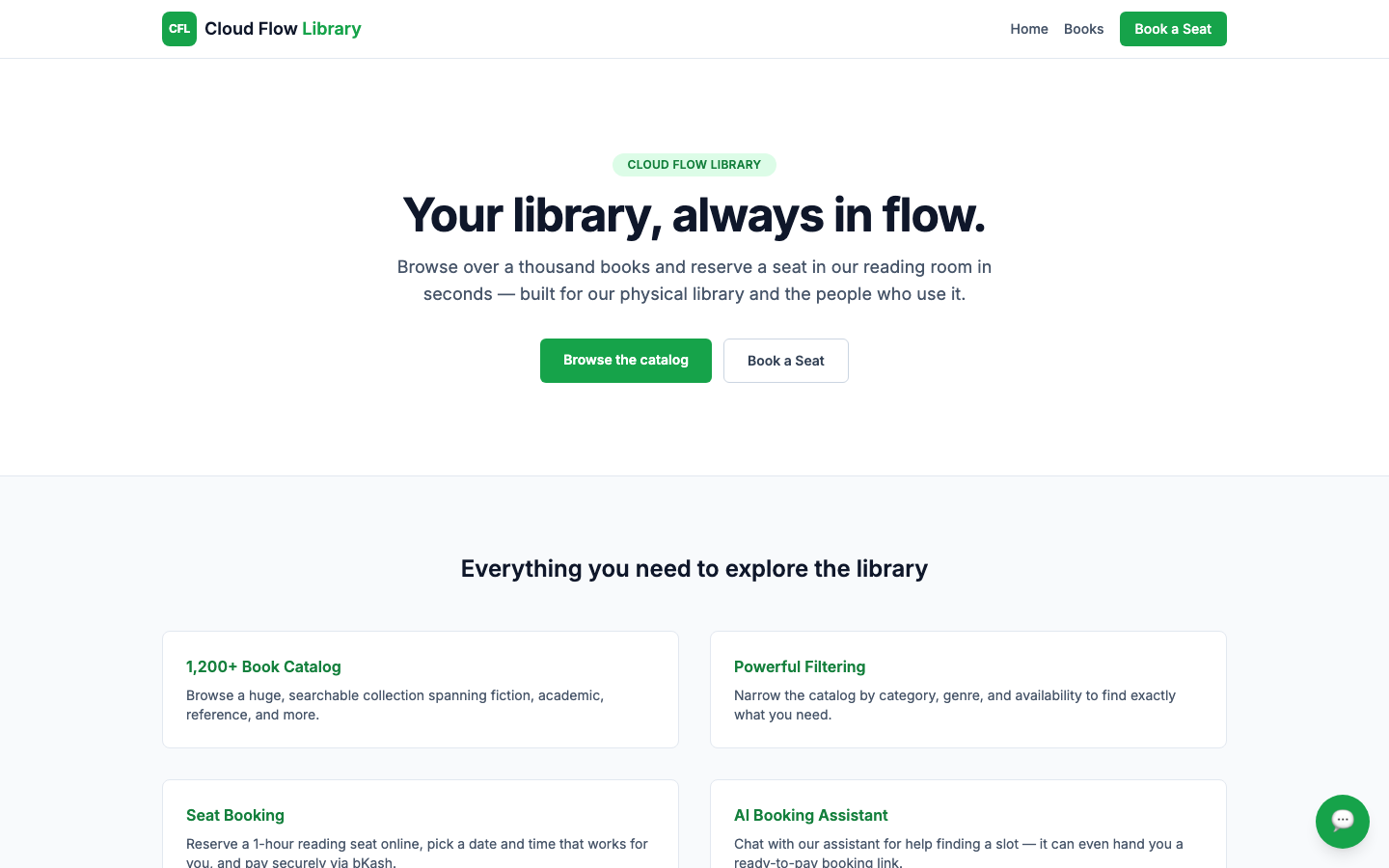
The same Dhaka library client I'd built a book-borrowing system for came back with a different need: a way for visitors to browse the catalog and pay to reserve a seat in the physical reading room online, instead of showing up and hoping a spot was free.
Timeline: 2026, rebuilt September 2026
The Challenge
The original borrowing-tracking system didn't fit what the client actually needed going forward — the real bottleneck was the reading room itself, with no way for a visitor to check seat availability or reserve one in advance, and no way to collect the seat fee without doing it in person. The rebuild had to drop the old borrowing model entirely rather than bolt a booking feature on top of it.
The Approach
A generated but fully browsable catalog
1,200 books, searchable by title or author and filterable by category, genre, and availability — open to any visitor, no account required.
Seat booking that respects real-world constraints
A calendar that only opens on the library's real days and hours (Saturday–Thursday, 9AM–9PM), 1-hour slots capped at 10 seats each, a 100 TK fee, and payment through bKash restricted to visitors inside Bangladesh.
An AI assistant that can finish the booking itself
A floating Gemini-powered chat widget, Flo, answers booking questions and — once it has a name, email, phone, date, and time from the conversation — hands back a ready-to-pay booking link, no form-hunting required.
Timezone bugs fixed at the root, not patched at the surface
Caught a real bug during the rebuild where date logic followed the server's own timezone, so "Saturday" could silently resolve to Friday (a closed day) depending on where it ran. Fixed by anchoring every date check to Asia/Dhaka and enforcing the closed-day/hours rule server-side on every path into a booking — the calendar UI, the chatbot's generated link, and a hand-typed URL alike — not just in the client-side calendar component.
The Results
- Replaced the old book-borrowing system entirely with a paid seat-booking model built around how the library actually operates day to day.
- Visitors can browse 1,200 books and book a reading-room seat in under a minute, with no account required.
- The AI assistant can carry a visitor from a plain-language question straight through to a ready-to-pay booking link.